
Stainless Steel Turnbuckles — Marine Grade Rigging Screws
316 stainless steel turnbuckles from 3/16" to 1-1/2", with working loads from 100 to 17,000 lb. Jaw, eye,…
View →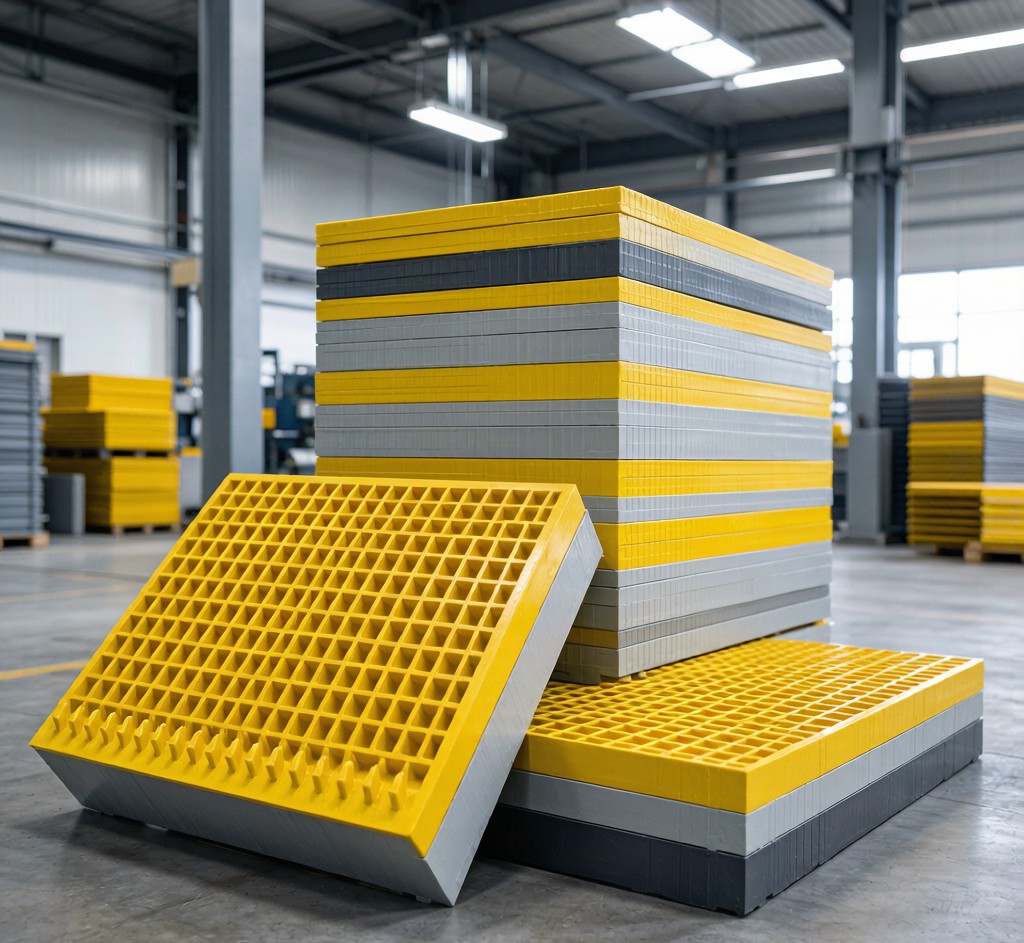
FRP grating (fiberglass grating) in molded and pultruded constructions for walkways, platforms and trench covers. Corrosion resistant, non-conductive, low maintenance. ASTM E84 Class 1 options available.
FRP grating — also written as fiberglass grating or GRP grating — is a composite panel built from glass fiber reinforcement and thermoset resin, produced by either molding or pultrusion. Each panel is an open grid: load-bearing bars run one way, cross bars the other, and the top face can be finished for slip resistance.
There are two constructions. Molded grating is formed in one piece, with load bars and cross bars sitting in one plane and a square or rectangular mesh, so it carries load in both directions. Pultruded grating uses pultruded profiles — I-bar, T-bar or wide T-bar — threaded onto notched cross rods and locked both mechanically and chemically; the result is higher load capacity and greater stiffness.
In most projects FRP grating replaces carbon or galvanized steel grating. It does not rust, it does not conduct electricity, and it does not need painting.
FRP grating is specified by construction, depth, mesh, panel size, resin type and top surface. Load tables are read against the required deflection limit rather than against rupture. Confirm the final specification against the span, the load case and the chemical environment before ordering.
Configurations
| Item | Options |
|---|---|
| Construction | Molded (square or rectangular mesh); pultruded (I-bar, T-bar, wide T-bar) |
| Depth (imperial) | 1 in, 1-1/2 in, 2 in (also 5/8 in, 3/4 in, 1-1/4 in) |
| Depth (metric) | 25 mm, 38 mm, 50 mm (also 22, 28, 30 mm) |
| Mesh | Molded 38 × 38 mm or 50 × 50 mm square; 19 × 19 mm fine; rectangular 1 in × 4 in, 1 in × 6 in |
| Standard panel | 1220 × 3660 mm (4 ft × 12 ft); also 3 ft × 10 ft, 4 ft × 8 ft, 5 ft × 10 ft, 6 ft × 4 ft |
| Long pultruded panel | 1000 × 6000 mm |
| Open area | Molded approx. 34–72 %; pultruded 25–60 % |
| Resin | Orthophthalic / isophthalic polyester, vinyl ester, phenolic; food-grade grades available |
| Colour | Grey, yellow, green, orange; RAL references available (e.g. RAL 7040, 7043, 1003, 6017) |
| Top surface | Concave, integrally molded grit or bonded grit (molded); bonded grit (pultruded) |
| Hold-down clips | Maximum 4 ft (approx. 1.2 m) spacing, minimum four per panel; 316 stainless steel common |
Design loads and deflection
| Application | Criterion |
|---|---|
| Walkway, uniform load | 50 psf (approx. 2.4 kN/m²), deflection 3/8 in (9.5 mm) or L/120 at mid-span |
| Walkway, concentrated load | 250 lb, deflection 1/4 in (6.4 mm) at mid-span |
| Walkway, European basis | 5.0 kN/m² |
| Stair treads | 100 psf uniform, or 300 lb line load at mid-span — whichever governs |
| Deflection limits (some makers) | L/240; or 1/200 of span with a 10 mm maximum |
| Covered grating | Apply a 0.5 factor to load tables (1 in to 2 in depths) |
Because FRP has a low modulus of elasticity and high tensile strength, service load is usually governed by allowable deflection rather than by rupture, and the acceptable limit is set by the specifier.
Weight examples
| Construction | Weight |
|---|---|
| Molded 25 mm, 38 × 38, 1220 × 3660 mm | Approx. 54 kg |
| Molded 38 mm, 38 × 38, 1220 × 3660 mm | Approx. 80 kg |
| Molded 38 mm, 19 × 19, 1220 × 3660 mm | Approx. 107 kg |
| Pultruded 1 in I-6010 | Approx. 2.35 lb/ft² (approx. 11.5 kg/m²) |
Standards commonly referenced in FRP grating specification
| Standard | Scope |
|---|---|
| ANSI/ASCE/ACMA FGM-2003 | FRP grating design manual |
| ASTM E84 | Surface burning characteristics (flame spread) |
| ASTM D635 | Rate of burning, horizontal (self-extinguishing) |
FRP grating is specified where corrosion, maintenance and electrical insulation drive the decision.
By application — industrial walkways, access and service platforms, trench covers, mezzanine decks, stair treads and tread covers, riser platforms, cable tray support, vehicle crossing points, jetties, marinas, gangways and pontoons, footbridges, handrails and ladders, debris screens.
By industry — chemical and petrochemical, oil and gas including offshore platforms, water and wastewater treatment, power generation and utilities, marine, pulp and paper, food and beverage, pharmaceutical, metal finishing, mining and refining, rail and tunnel, renewables, construction, and data centres.
Resin selection by environment — isophthalic polyester for general corrosion; vinyl ester for severe acids, caustics and salt spray; phenolic for tunnel, offshore and transit projects with fire and smoke requirements; food-grade isophthalic polyester for food contact.
How does FRP grating differ from steel grating? It does not rust, does not conduct electricity and needs no painting. Load capacity is achieved through section design and glass content rather than through the base material.
Should I choose molded or pultruded grating? Molded grating carries load in two directions and suits general platforms and walkways. Pultruded grating delivers higher load capacity and stiffness over longer spans.
What is the standard panel size? 1220 × 3660 mm (4 ft × 12 ft) is the most widely used standard panel.
What fire rating is available? ASTM E84 flame spread at or below 25 (Class 1) is standard across most of the range; selected resin systems achieve 10 or less.
How are walkway loads specified? A common basis is 50 psf uniform load with deflection limited to 3/8 in or L/120 at mid-span.
Other options: customized colours and RAL matching, fire-retardant and food-grade resin systems, anti-slip surfaces in several grit grades, prefabricated stair treads and covers, fabricated platforms, and cut-to-size panels with sealed edges.