
AISI 316 is the grade most stainless steel rope mesh is specified in, and the reason is corrosion rather than fashion. It is also the grade whose European designation trips people up: AISI 316 and EN 1.4401 are the same material under two naming systems. This page covers what the grade means, how the wire rope inside the mesh is built, the breaking loads behind each diameter, and the approvals that decide whether a fall-protection project can proceed.
Quick answer
AISI 316 rope mesh is built from wire rope that corresponds to EN 1.4401; the low-carbon variant 316L corresponds to EN 1.4404. The mesh itself is normally woven from 7×7 wire rope, with ø1.5 mm as the standard mesh cable and ø1.0–5.0 mm available across the range. Two approvals matter on regulated work: the German general building approval DIBt Z-14.7-557 for fall protection, and the European Technical Assessments (ETA) that cover the cable net system and the wire-rope system it is assembled with.
What AISI 316 / EN 1.4401 actually means
Rope mesh is normally specified in AISI 316 or 316L wire, equivalent to European grades EN 1.4401 and EN 1.4404. In either case the finished product is an AISI 316 rope mesh, and it carries the corrosion performance of the wire it is woven from. Both designations describe the same alloy family: 316L is the low-carbon variant and 316 the standard one. Both are noted for high corrosion resistance and ease of processing.
The same wire range also runs AISI 304 and Duplex 2205, aimed at different corrosion duties. AISI 304 is the economical choice for non-coastal sites where there is little movement. Duplex 2205 is a two-phase stainless that adds strength on top of corrosion resistance and is used where a thinner rope has to carry more.
Wire suppliers print AISI 316 and DIN 1.4401 side by side in their catalogues. On a purchase order the two designations name the same material, so do not treat a supplier's use of one or the other as a discrepancy. It is the most common misreading on an AISI 316 rope mesh order.
Wire construction: 7×7, 1×19 and 7×19
7×7 delivers high flexibility and bends or wraps easily, which is why it is the usual construction in architectural rope mesh. Seven strands of seven wires each give a rope that takes a tight bend radius without kinking.
1×19 resists stretching and resists bending, which suits applications where stiffness and support matter rather than flexibility. Abrasion resistance is another advantage, which makes it durable in harsh outdoor conditions.
7×19 mirrors 7×7 on flexibility and suits routing that bends often while carrying higher loads.
Inside an AISI 316 rope mesh the mesh cable itself normally runs ø1.5 mm with a mesh width range of 40–180 mm. That is the size band most architectural rope mesh is quoted in.
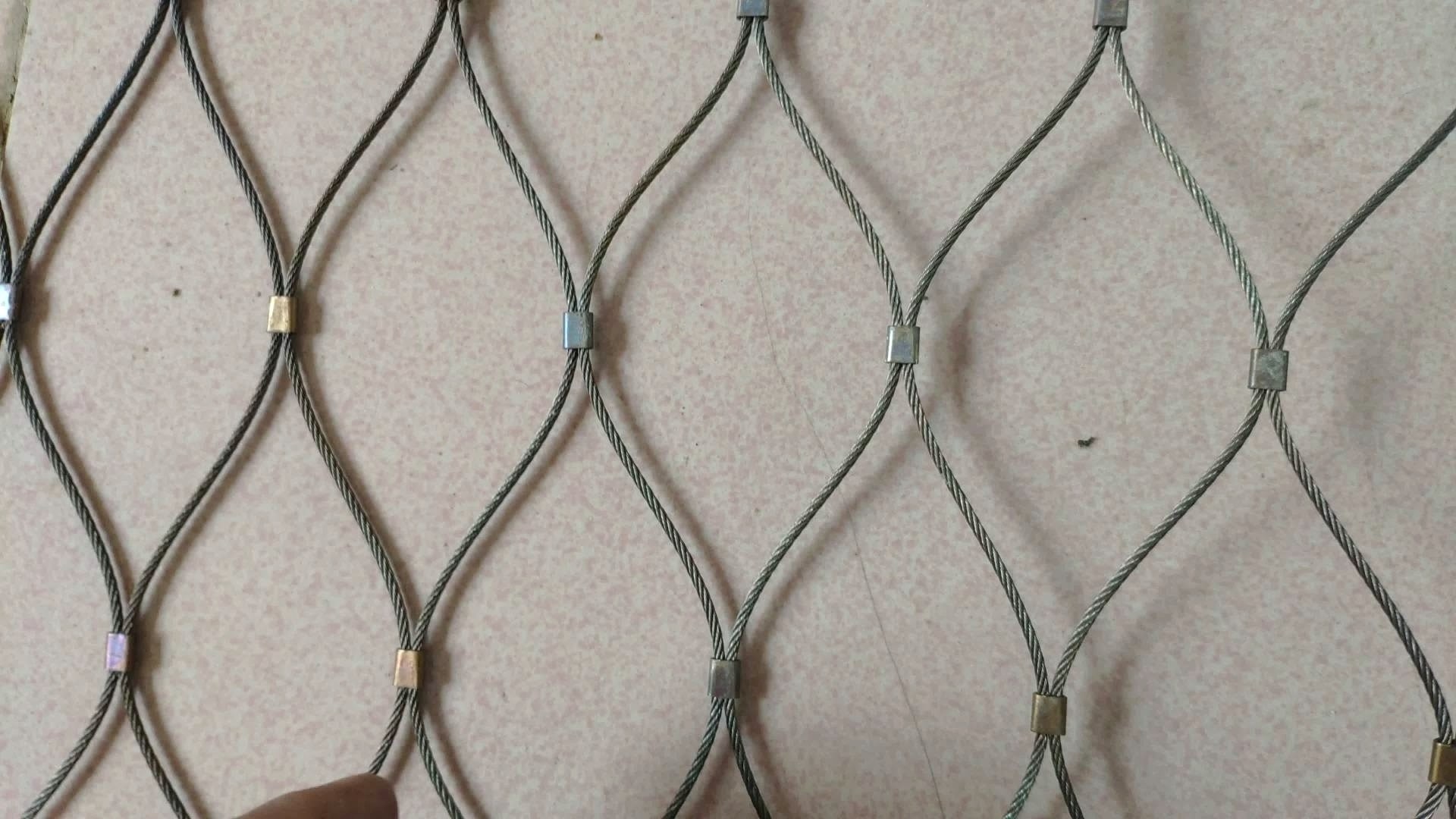
Breaking loads for 316-grade 7×7 wire rope
Minimum breaking strength for 316-grade 7×7 wire rope rises with diameter: 0.6 kN at ø1.0 mm, 5.7 kN at ø3.0 mm and 81.1 kN at ø12 mm. Breaking strength is not working load, and design has to apply the project safety factor on top of these figures.
| Diameter ø | Construction | Min. breaking strength (kN) | Min. breaking strength (kgf) | Weight (kg/m) |
|---|---|---|---|---|
| 1.0 mm | 7×7 | 0.6 | 59 | 0.005 |
| 2.0 mm | 7×7 | 2.5 | 258 | 0.017 |
| 3.0 mm | 7×7 | 5.7 | 581 | 0.037 |
| 5.0 mm | 7×7 | 15.9 | 1,620 | 0.105 |
| 10.0 mm | 7×7 | 56.3 | 5,741 | 0.410 |
| 12.0 mm | 7×7 | 81.1 | 8,270 | 0.577 |
In mesh construction the rope is not loaded to anything like these figures, because the load is shared across many crossings and taken to the edge cables. The table matters for sizing terminations and edge supports, and for checking that a single damaged cable can be replaced without taking the panel out of service. Those are the numbers that turn a coil of wire rope into a rated AISI 316 rope mesh.
Two approvals that decide whether the project proceeds
Fall protection is where an AISI 316 rope mesh stops being a design choice and becomes a regulated product. The German Institute for Building Technology (DIBt) issues general building approval Z-14.7-557, which covers the net both horizontally and vertically. A general building approval is not a test report; it is a licence to use a system in a regulated application, and specifying it moves the question of suitability from the designer to the approval holder.
The systems behind the mesh carry their own European Technical Assessments: ETA-13/0650 covers the stainless steel cable net system, and ETA-10/0358 covers the wire-rope system it is assembled with. ETA documents are published through EOTA, the European Organisation for Technical Assessment, where the scope and the validity dates can be checked against the document number on the drawing.
Quality-system certificates are a separate layer again. When a supplier presents one, ask for the certificate number, the issuing body, the expiry date and the exact scope — the scope wording is what tells you whether the mesh products and the systems they belong to are actually inside it.
Five applications and what each one needs
Railings and balustrades. The brief is visual neutrality: the mesh has to do a safety job without reading as a barrier. 40 mm mesh on ø1.5 mm rope is the normal answer.
Fall protection. Observation platforms, stadium concourses and stairwells. Design has to stay inside the DIBt Z-14.7-557 scope, and rope diameter steps up to carry the imposed load.
Facade greening. The mesh acts as a climbing trellis: easy to install, low-maintenance, and able to cover a whole facade or just a panel of one. On insulated facades it is carried on thermally separated brackets so the greenery stands off the building fabric.
Sport. Ball-catching fences in rope mesh are quieter than conventional wire fencing and almost invisible from the stands. The same material serves as ceiling protection in sports halls.
Zoo enclosures. Transparency is what removes the cage look, and the mesh can be shaped into enclosures and aviaries that do not read as boxes.
On the support side, one cable system spans rope diameters from 1 mm to 26 mm with more than 1,000 individual parts for on-site assembly, which is what allows the same AISI 316 rope mesh to be detailed for a small balcony or a whole facade.
Application-to-specification matrix
| Application | Mesh | Rope ø | Key constraint |
|---|---|---|---|
| Balustrade infill | 40–60 mm | ø1.5–2.0 mm | Opening <40 mm to sit inside the climbability threshold |
| Fall protection | 40–60 mm | from ø3.0 mm | Must stay inside the DIBt Z-14.7-557 scope |
| Facade greening | 60–180 mm | ø1.5–3.0 mm | Stocked range, light transmission first |
| Ball-catching fence | 60–120 mm | ø2.0–3.0 mm | Impact absorption, low noise |
| Zoo enclosure | 40–100 mm | ø2.0–3.0 mm | Transparency matched to animal scale |
| Marine and offshore | Per design | ø1.0–12 mm (7×7) | AISI 316 or Duplex 2205 |
FAQ
Is AISI 316 the same as EN 1.4401?
Yes. AISI 316 maps to EN / DIN 1.4401, and the low-carbon 316L maps to EN 1.4404. The two naming systems describe the same material composition.
Which wire construction should rope mesh use?
7×7 is the standard: flexible and easy to bend around terminations. Move to 1×19 when stiffness and support are needed rather than flexibility.
Why do projects cite DIBt or ETA numbers?
Because fall protection and tension components are regulated uses. DIBt Z-14.7-557 covers the net; the ETAs cover the cable net and wire-rope systems behind it. Citing the number tells the reviewer which approval the design relies on.
Can rope mesh be used on marine projects?
Yes. That is what an AISI 316 rope mesh is for: marine, offshore and architectural duty, where chloride exposure rules out a lower grade.
Where to go next
Mesh width, rope diameter and mesh angle are covered in detail in our guide to stainless steel rope mesh specification. The two constructions we build are ferrule type rope mesh and knotted rope mesh, and the fittings that hold them are in the marine hardware range. To price a project, use the quote service and send the panel sizes and the application.