
The three numbers that settle a stainless steel rope mesh specification are mesh width (MW), rope diameter (ø) and mesh angle (α). Fix those three and load capacity, unit weight, light transmission and climbability all follow from them. Leave them loose and the mesh either sags, overloads its fixings, or fails a safety review it should have passed.
Quick answer
Fix three figures and a stainless steel rope mesh specification is essentially complete. Railing infills normally run 40 mm mesh on ø1.5–2.0 mm rope at a 60° mesh angle. An opening of 40 mm or less is the accepted threshold for a surface that is difficult to climb. 60° is the angle at which the net holds its most stable tension and quantity take-off is simplest. Set mesh width first, because the safety or design function fixes it; rope diameter then follows from the load you need and the weight per square metre you can accept.
Mesh width is not hole size
In a stainless steel rope mesh, mesh width is the centre-to-centre distance between two neighbouring ferrules, measured along the mesh cable. It is not the diameter of the opening, and the two are not interchangeable. This matters in practice because tenders are usually written in mesh width while climbability rules are written in opening size — and those are different numbers.
The standard mesh angle is 60°. At that angle every diamond divides into two equilateral triangles, the mesh width and the ferrule spacing along the cable become numerically equal, and the net sits at its most stable tension.
Rope diameter and mesh width then have to be read together. A thicker rope at a tighter mesh raises the load capacity, and raises unit weight and visual obstruction along with it. The three figures move as one set, not three independent choices.
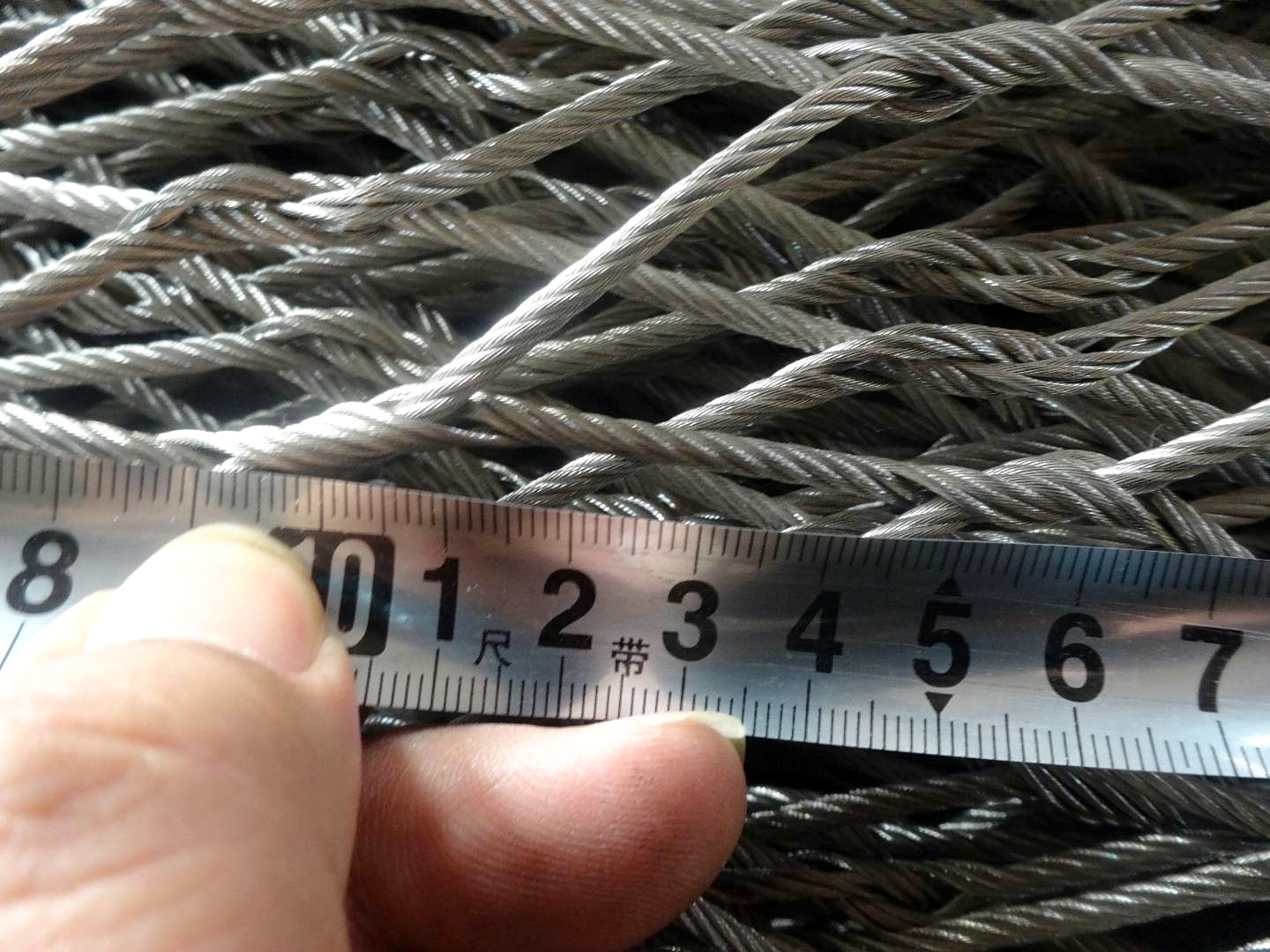
Why 40 mm is the practical climbability threshold
No binding standard covers the climbability of stainless steel rope mesh used in railings and vertical structures. The working reference in Swiss practice is the accident-prevention document BFU 2.003, Railings and Balustrades, which classifies mesh with an opening of 40 mm or less as difficult to climb. It is published by BFU, the Swiss accident-prevention agency, and is commonly specified in Swiss railing tenders.
What gets judged is the passage a person can actually fit through, not the nominal mesh figure on the drawing. The opening has to stay below 40 mm; rectangular and circular openings both qualify.
In Swiss railing tenders the typical requirement is 40 mm mesh, corresponding to an opening geometry of roughly 40 × 75 mm. Kindergartens, playgrounds and hospitals carry tighter requirements: either a smaller passage dimension, or the mesh installed in a vertical orientation.
Rope diameter and mesh weight at 40 mm mesh
At the same 40 mm mesh and the same 60° angle, moving rope diameter from ø1.0 mm to ø3.0 mm takes the unit weight of the finished net from 0.51 kg/m² to 4.10 kg/m², and drops light transmission from 92.4% to 74.3%. The table below lists the standard stock steps.
| Rope ø | Construction | Unit weight | Mesh aperture | Light transmission |
|---|---|---|---|---|
| 1.0 mm | Sleeved | 0.51 kg/m² | 1,318 mm² | approx. 92.4% |
| 1.5 mm | Sleeved | 0.85 kg/m² | 1,361 mm² | approx. 88.6% |
| 2.0 mm | Sleeved | 1.54 kg/m² | 1,308 mm² | approx. 84.3% |
| 1.5 mm | Sleeveless | 0.59 kg/m² | 1,370 mm² | approx. 91.6% |
| 2.0 mm | Sleeveless | 1.09 kg/m² | 1,328 mm² | approx. 88.8% |
| 3.0 mm | Sleeved | 4.10 kg/m² | 1,198 mm² | approx. 74.3% |
Read the table for the trade-off, not for a single favourite row. Doubling rope diameter from 1.5 mm to 3.0 mm multiplies unit weight by roughly five, and the fixing loads scale with it. At the other end, aircraft-cable-thin rope keeps the net almost invisible but carries very little lateral load. Both ends of that range are still a stainless steel rope mesh — what changes is the balance between load and openness.
Construction matters at the same nominal size. At ø1.5 mm and 40 mm mesh, the sleeveless version is 0.26 kg/m² lighter than the sleeved one and roughly three percentage points more transparent, because nothing is added to the cable at the intersections.
Why the 60° mesh angle drives tension and take-off
At a 60° mesh angle the mesh width and the ferrule spacing along the mesh cable are numerically equal. That equality is what puts the net into its ideal tension state and what keeps the take-off calculation simple, which is why 60° is the standard and not simply a habit.
Panel height can be adapted by roughly ±100 mm just by changing the mesh opening angle, with no change to the cut sizes. That is useful on refurbishment work where the measured opening rarely matches the drawing.
For stainless steel rope mesh the stocked mesh range runs 40–180 mm. In balustrade work the three sizes actually ordered are 40, 50 and 60 mm. Once the angle departs from 60°, the real aperture behind a given nominal mesh figure changes, so nominal numbers alone are not enough for selection.
Sleeved or sleeveless construction
The sleeved construction is versatile and economical, particularly at small rope diameters, and is the usual answer where design intent and cost sit ahead of everything else. Ferrules or sleeves are pressed onto the cable at each intersection, which adds material and a small amount of visual weight.
The sleeveless construction interweaves the rope wires by piercing them together. Nothing is added at the intersections, so it loses less light and suits nets that have to combine strength with the widest possible view. Both constructions produce a stainless steel rope mesh of the same nominal mesh width; only weight and light transmission change.
Selection quick reference
| Use case | Mesh | Rope ø | Basis |
|---|---|---|---|
| Standard balustrade infill | 40 mm (opening approx. 40 × 75 mm) | ø1.5–2.0 mm | Opening ≤40 mm climbability threshold; common Swiss tender geometry |
| Kindergarten, playground, hospital | <40 mm, or vertical mesh orientation | ø1.5 mm | Tighter passage requirement |
| Large-format decorative mesh | 60–120 mm | ø1.5–2.0 mm | Light transmission in the 92–96% band, weight ≤0.5 kg/m² |
| Facade greening, climbing trellis | 60–180 mm | ø1.5–3.0 mm | Standard stocked mesh range |
| Fall protection, high load | 40–60 mm | ø3.0 mm and above | Heavy duty band from 4.1 kg/m² |
Every row assumes a 60° mesh angle. Change the angle and the mesh column has to be re-read against the actual opening, not the nominal size.
FAQ
Is 40 mm the smallest mesh available?
No. 40 mm is the practical threshold for railing work. Where a facility demands a harder-to-climb surface, mesh goes smaller or the orientation goes vertical.
How large can a single panel be?
The production length limit applies to the horizontal mesh direction only. Height carries no production limit; total panel weight is what actually constrains the size, because it decides how many people and what lifting gear the installation needs.
Does it have to be AISI 316?
AISI 304 suits non-coastal sites where there is little movement. For outdoor, coastal or wet conditions specify AISI 316 / EN 1.4401. Duplex 2205 is also available in the same wire range. Grade selection for a stainless steel rope mesh is covered in detail in our guide to AISI 316 rope mesh.
Which comes first — mesh size or rope diameter?
Mesh size, because the safety or design function fixes it. Rope diameter then follows from the required load and the weight per square metre you can accept.
Where to go next
These figures apply to the two rope net constructions we build: ferrule type rope mesh for sleeved and sleeveless crossover joints, and knotted rope mesh where a knotted node is preferred. Both sit under the stainless steel rope net range. If you already have a drawing, send it to our quote service and we will come back with mesh width, rope diameter, panel sizes and fixing spacing for your opening.