
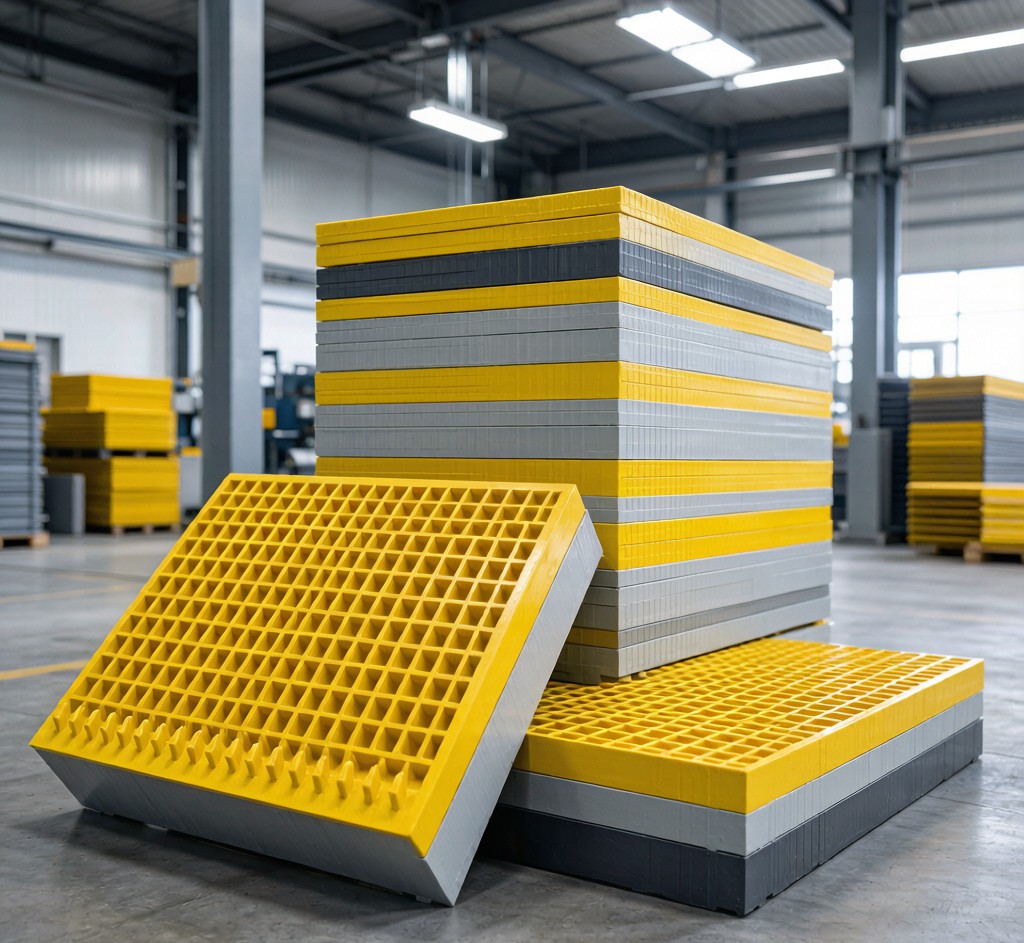
Why Choose FRP Grating? Key Advantages at a Glance
Fiberglass Reinforced Plastic (FRP) grating has become the material of choice for industrial flooring, walkways, and platforms across demanding industries worldwide. Unlike traditional materials such as steel and aluminum, FRP grating delivers a unique combination of corrosion resistance, high strength-to-weight ratio, and long-term durability that translates directly into lower total cost of ownership. Below, we examine each advantage in detail.
1. Superior Corrosion Resistance
FRP grating is inherently resistant to a broad spectrum of chemicals, including acids, alkalis, salts, and organic solvents. Unlike steel grating, which rusts and degrades rapidly in corrosive environments, FRP grating maintains its structural integrity for 30 to 50 years with minimal maintenance. This makes it the ideal solution for:
- Chemical processing plants with continuous exposure to aggressive substances
- Marine and offshore platforms exposed to saltwater spray
- Wastewater treatment facilities handling corrosive effluents
- Electroplating and metal finishing shops with acidic atmospheres
- Pulp and paper mills with bleaching chemicals
2. High Strength-to-Weight Ratio
FRP grating delivers strength comparable to steel at only one-quarter the weight. A typical FRP grating panel weighs approximately 25% of an equivalent steel panel, resulting in significant advantages:
- Reduced structural support requirements — lighter dead loads on buildings and frameworks
- Easier handling and faster installation — no heavy lifting equipment needed
- Lower transportation costs — more panels per shipment
- Simplified on-site cutting and fabrication using standard carbide-tipped tools
3. Fire Retardant Performance
FRP grating can be manufactured with fire-retardant resins that meet international fire safety standards. Phenolic-based FRP grating offers the highest level of fire resistance with low smoke emission and low toxicity — critical for enclosed or occupied spaces. Key fire safety features include:
- ASTM E-84 Class 1 flame spread rating available
- Low smoke density — improved visibility during evacuation
- Self-extinguishing properties in certain resin formulations
- Compliance with IMO FTP Code for marine applications
4. Non-Conductive and Non-Magnetic
FRP grating is electrically non-conductive, making it the safest choice for electrical substations, transformer rooms, battery storage areas, and any environment where electrical hazards exist. Unlike metal grating, FRP eliminates the risk of accidental electrical shock and does not interfere with sensitive electronic equipment. Its non-magnetic properties also make it suitable for MRI facilities and specialized research environments.
5. Anti-Slip Surface for Workplace Safety
Worker safety is paramount in industrial environments. FRP grating panels are manufactured with an integral grit-top or concave anti-slip surface that provides excellent traction even when wet, oily, or covered in debris. The anti-slip surface is molded directly into the panel — not applied as a coating — ensuring consistent slip resistance throughout the product’s service life. Typical coefficient of friction values exceed OSHA and international safety requirements.
6. UV and Weather Resistance
FRP grating formulated with UV-stabilized resins and a synthetic surface veil resists degradation from prolonged sun exposure. Unlike some plastics that become brittle and discolored outdoors, high-quality FRP grating retains its mechanical properties and appearance after years of outdoor service. An integral UV protection layer also inhibits fiber bloom — the exposure of glass fibers at the surface due to weathering.
7. Low Maintenance — No Painting, No Rust Treatment
Steel grating requires periodic sandblasting, priming, and painting to combat rust. Aluminum grating can experience galvanic corrosion. FRP grating requires none of this. A simple water wash or mild detergent rinse is typically all that is needed to keep FRP surfaces clean and functional. Over a 30-year service life, the maintenance savings alone often exceed the initial material cost.
8. Excellent Dimensional Stability
FRP grating exhibits minimal thermal expansion and contraction compared to thermoplastics. It maintains flatness and structural integrity across a wide temperature range, typically from -40°C to +120°C (-40°F to +250°F), depending on the resin system. This dimensional stability ensures reliable fit and performance in both arctic cold and desert heat.
9. Design Flexibility and Customization
FRP grating can be manufactured in virtually any color by incorporating pigments directly into the resin. Common colors include yellow (safety), green, gray, and orange, but custom RAL color matching is available. Panel sizes, mesh configurations, thicknesses, and resin formulations can all be tailored to specific project requirements. Unlike metal grating, FRP panels can be produced in complex shapes and sizes without expensive die modifications.
FRP Grating vs Traditional Materials: Detailed Comparison
| Property | FRP Grating | Steel Grating | Aluminum Grating |
|---|---|---|---|
| Weight | Lightweight (~25% of steel) | Heavy | Lightweight |
| Corrosion Resistance | Excellent — resists acids, alkalis, salts | Poor — rusts, requires coating | Moderate — galvanic corrosion risk |
| Strength-to-Weight | High | High | Moderate |
| Electrical Conductivity | Non-conductive | Conductive | Conductive |
| Fire Rating | Class 1 available (ASTM E-84) | Non-combustible | Non-combustible |
| UV Resistance | Excellent (with UV inhibitors) | Requires coating | Good |
| Maintenance | Minimal — wash only | High — paint, rust treatment | Low-Medium |
| Service Life | 30–50 years | 10–20 years (coated) | 20–30 years |
| Installation | Easy — standard tools | Requires heavy equipment | Easy |
| Anti-Slip | Integral grit surface | Serrated or applied coating | Serrated options |
Long-Term Cost Advantage
While the initial material cost of FRP grating may be higher than basic steel grating, the total lifecycle cost is significantly lower when factoring in:
- Eliminated painting and corrosion treatment costs (saves $5–15 per square foot over lifespan)
- Reduced installation labor (lighter weight = faster installation)
- Zero replacement costs for 30+ years (steel typically replaced at 10–15 years)
- Lower structural steel requirements due to reduced dead load
- No production downtime for grating maintenance or replacement
Industry studies show that FRP grating delivers a 50–70% reduction in total cost of ownership compared to steel grating over a 30-year service period.
Industries That Rely on FRP Grating
- Chemical processing and petrochemical
- Oil and gas (onshore and offshore)
- Water and wastewater treatment
- Marine, shipbuilding, and port facilities
- Power generation (including nuclear and renewable)
- Mining and mineral processing
- Food and beverage processing
- Pulp and paper manufacturing
- Pharmaceutical production
- Architectural and commercial construction
For more information about product specifications, please visit our Products page or contact our team for a customized solution.