
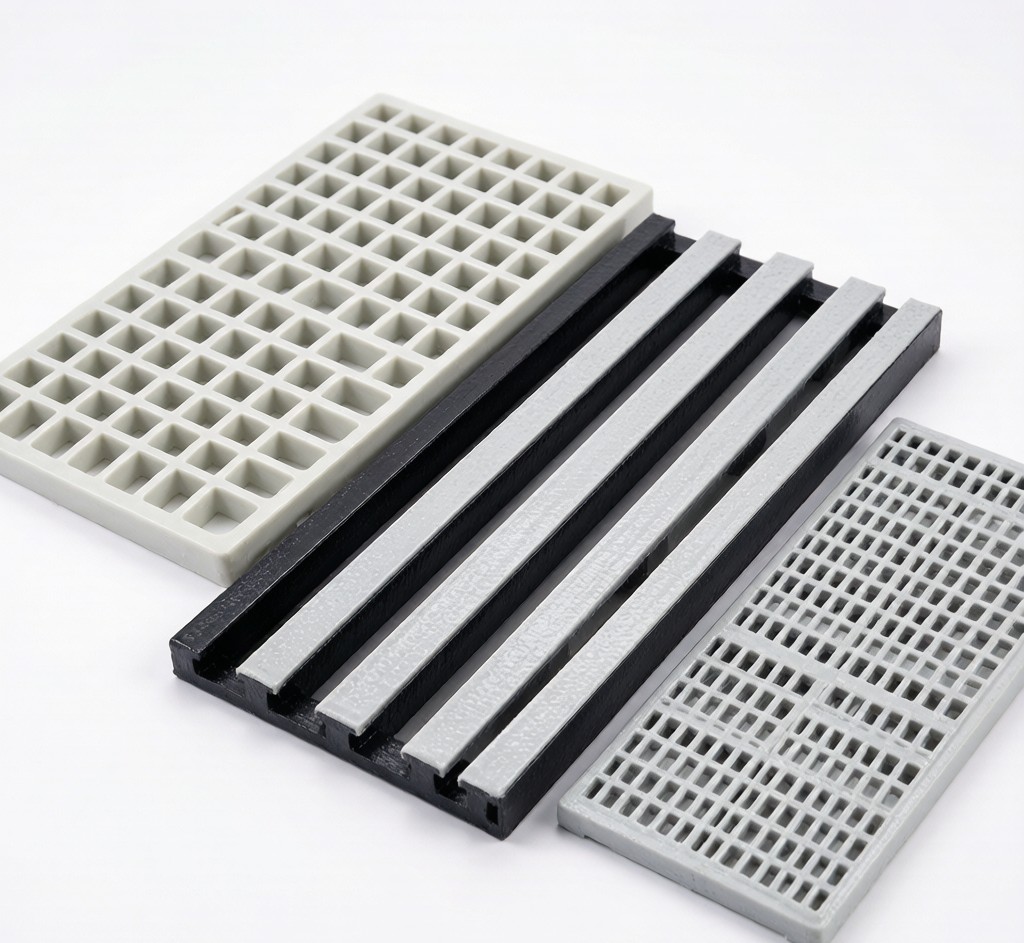
Understanding FRP Grating Types: Which One Do You Need?
FRP (Fiberglass Reinforced Plastic) grating is not a one-size-fits-all product. Different manufacturing processes, resin systems, mesh configurations, and surface treatments produce distinct types of grating — each optimized for specific load requirements, environmental conditions, and application scenarios. This guide breaks down every major category to help you select the right type for your project.
Classification by Manufacturing Process
1. Molded FRP Grating
Molded FRP grating is produced by laying continuous fiberglass strands in a mold and saturating them with liquid resin. The grid pattern is formed by interweaving the glass fibers in both directions, creating a monolithic panel with bi-directional strength. After curing, the panel is removed from the mold as a single piece.
- Mesh patterns: Square (standard), rectangular
- Mesh sizes: Commonly 38mm × 38mm (1.5″ × 1.5″), 50mm × 50mm (2″ × 2″)
- Thickness range: 25mm to 50mm (1″ to 2″)
- Panel sizes: Standard 1220mm × 3660mm (4′ × 12′), custom available
- Best for: General industrial flooring, chemical exposure, marine environments
- Key advantage: Highest corrosion resistance, excellent bi-directional load distribution
2. Pultruded FRP Grating
Pultruded FRP grating is manufactured by pulling continuous glass fiber rovings through a resin bath and then through a heated forming die. This continuous process produces strong, rigid bearing bars with unidirectional strength. The bars are then assembled with cross-rods to form grating panels.
- Bar profiles: I-bar, T-bar, rectangular solid bar
- Bearing bar depth: 25mm to 100mm (1″ to 4″)
- Panel sizes: Custom widths and lengths up to 12m
- Fiber content: Typically 60–70% by weight (higher than molded)
- Best for: Long spans, heavy loads, bridge decking, vehicular traffic
- Key advantage: Superior unidirectional strength, ideal for long-span applications
Molded vs Pultruded: Quick Comparison
| Feature | Molded FRP Grating | Pultruded FRP Grating |
|---|---|---|
| Strength direction | Bi-directional | Unidirectional (span direction) |
| Fiber content | 30–40% by weight | 60–70% by weight |
| Typical span range | Up to 1.5m | Up to 6m (with deep bars) |
| Mesh size flexibility | Fixed by mold | Adjustable bar spacing |
| Cost (relative) | Moderate | Higher |
| Cutting ease | Easy — any direction | Easy along bars; harder across bars |
Classification by Resin System
1. Polyester (Isophthalic) FRP Grating
The most widely used and cost-effective resin system. Isophthalic polyester offers good corrosion resistance against a range of chemicals and is suitable for general industrial environments. It provides reliable performance in most applications where extreme chemical or temperature resistance is not required.
- Good resistance to mild acids, water, and weathering
- Operating temperature: -40°C to +80°C
- Standard color: Green, gray, yellow
2. Vinyl Ester FRP Grating
Vinyl ester resin offers significantly enhanced chemical resistance compared to polyester, particularly against strong acids, alkalis, and oxidizing agents. It also provides superior mechanical properties at elevated temperatures.
- Excellent resistance to strong acids (HCl, H₂SO₄) and caustic solutions
- Higher elongation and toughness than polyester
- Operating temperature: -40°C to +100°C
- Common in chemical processing and chlorine-related environments
3. Phenolic FRP Grating
Phenolic resin-based FRP grating delivers the highest fire performance in the FRP family. It produces very low smoke and virtually no toxic fumes when exposed to flame, making it mandatory for offshore platforms, shipboard applications, and enclosed public spaces.
- Class 1 flame spread (ASTM E-84) — lowest in class
- Low smoke density and toxicity
- Operating temperature: up to +150°C continuous
- Compliant with IMO FTP Code and USCG requirements
- Specified for: Offshore platforms, naval vessels, tunnels, mass transit
Resin Selection Guide
| Resin Type | Corrosion Resistance | Fire Rating | Max Temp | Relative Cost |
|---|---|---|---|---|
| Polyester (Iso) | Good | Class 2–3 | 80°C | $ (lowest) |
| Vinyl Ester | Excellent | Class 2 | 100°C | $$ |
| Phenolic | Good | Class 1 | 150°C | $$$ |
Classification by Surface Type
1. Grit-Top (Anti-Slip) FRP Grating
The walking surface is coated with a quartz or aluminum oxide grit embedded in the resin during manufacturing. This creates a permanently bonded, highly abrasive surface that provides excellent slip resistance — even under oil, grease, or water. Grit-top is the standard choice for industrial walkways, platforms, and stair treads where worker safety is critical.
2. Concave (Meniscus) Surface FRP Grating
The top surface of each bearing bar is slightly concave (curved inward), creating a natural grip profile. This surface type offers good slip resistance without the added grit layer and is easier to clean — making it preferred for food processing, pharmaceutical, and hygiene-sensitive applications.
3. Covered (Solid Top) FRP Grating
A solid FRP plate is bonded to the top surface of a standard grating panel, creating a completely sealed walking surface. This design prevents liquids and debris from passing through while maintaining the lightweight advantage of FRP. Ideal for areas requiring spill containment, splash protection, or pedestrian walkways over sensitive equipment.
Specialty FRP Grating Products
Mini-Mesh FRP Grating
Features a smaller mesh opening (typically 20mm × 20mm or smaller) designed for pedestrian comfort, wheelchair accessibility, and environments where small objects or high heels could become trapped in standard openings. Common in public infrastructure, commercial buildings, and shopping centers.
FRP Stair Treads
Pre-fabricated stair treads with molded anti-slip nosing, available in standard widths and depths. Can be manufactured as single panels covering the full stair width, with color-contrasting nosing for visibility. Designed to comply with OSHA, IBC, and international building code requirements.
FRP Heavy-Duty Grating
Manufactured with increased bearing bar depth (up to 100mm) and higher fiber content for applications subject to forklift traffic, heavy vehicles, and extreme point loads. Commonly specified for loading docks, bridge decks, and industrial driveways.
How to Choose the Right FRP Grating Type
- Identify the chemical environment → Select the appropriate resin system
- Calculate the required load and span → Choose molded or pultruded, determine bar depth
- Assess fire safety requirements → Determine if phenolic is necessary
- Evaluate slip resistance needs → Select grit-top, concave, or covered surface
- Consider pedestrian comfort → Choose mesh size; use mini-mesh where appropriate
- Review installation constraints → Verify panel sizes, cutting requirements, and fastening system
For expert guidance on selecting the right FRP grating for your specific application, contact our engineering team with your project requirements. We provide free technical consultation and load calculations.